


Safe Hands, Silent Yards
The horse world has always adored the phrase:
“We’re like a family.”
Unfortunately, as several federations across Europe are now discovering, families become considerably less charming once lawyers, safeguarding officers and police investigations arrive carrying clipboards.
In recent years, equestrian sport has been repeatedly shaken by allegations involving trainers, coaches and riding school owners accused of abusing positions of trust.
The latest scandals emerging in Norway and France have once again forced the industry to confront a deeply uncomfortable reality:
horse sport is exceptionally good at teaching people how to sit quietly.
And not only on horses.
The British Equestrian Federation this week launched renewed safeguarding initiatives reminding the sport that:
“Abuse of a position of trust isn’t always obvious. It can be subtle and easy to miss if we’re not paying attention.”
Which is an admirably diplomatic way of saying:
“Perhaps we should stop ignoring alarming behaviour simply because somebody owns an expensive horse lorry and shouts confidently in jodhpurs.”
Because the uncomfortable truth is that equestrian sport has historically created the perfect ecosystem for silence.
Young riders are taught:
obedience,
discipline,
respect for authority,
and the deeply ingrained belief that powerful trainers must never be questioned because:
“That’s just how top horse people are.”
Add:
hero worship,
isolated yard culture,
vulnerable teenagers,
financially dependent staff,
and charismatic authority figures,
and suddenly safeguarding stops looking like a bureaucratic inconvenience and starts looking like basic survival equipment.
The sport, naturally, prefers discussing almost anything else.
For years, federations have held emergency meetings on:
nosebands,
social licence,
foam,
blood rules,
and whether horses experience emotional fulfilment through carrot-based enrichment activities.
Meanwhile, safeguarding often sat quietly in the corner wearing a fluorescent tabard nobody wanted to acknowledge.
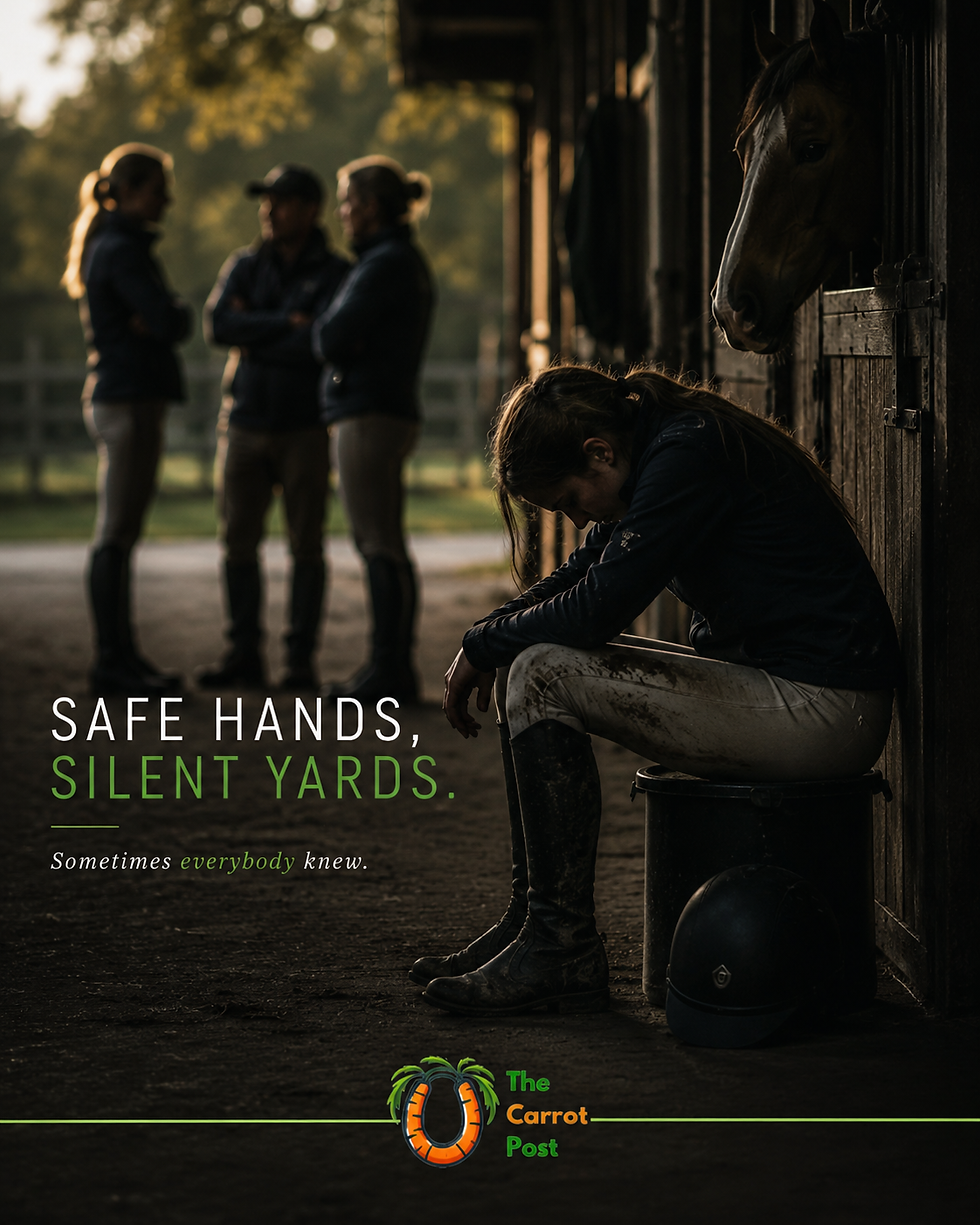
For many people in the sport, these stories are not abstract governance discussions.
They are memories.
Global Equestrian Federation President Alejandro “Alex” Ferreira released a carefully polished statement declaring:
“The welfare and safety of all participants in equestrian sport remains central to the GEF vision for a sustainable future.”
Which, while undeniably correct, did leave some observers wondering why safeguarding language in horse sport often sounds as though it was written by a committee of diplomatic furniture.
German dressage rider Helga Müller appeared visibly uncomfortable discussing the issue publicly.
“The vast majority of trainers are dedicated professionals,” she insisted firmly. “We must be careful not to create hysteria around coaching relationships.”
Which is true.
But as welfare advocate Dr. Leila Al-Farsi later pointed out:
“No serious safeguarding system is built on the assumption that abuse is everywhere. It is built on the understanding that silence allows abuse to survive where it does exist.”
A sentence which reportedly caused several federation executives to shift uncomfortably in their seats.
Perhaps the deepest problem is cultural.
Because the horse world worships toughness.
Young riders learn early:
don’t complain,
don’t cry,
don’t be difficult,
don’t challenge authority,
and absolutely do not upset the trainer everybody depends on for results.
In many yards, reputation still outranks welfare.
Sometimes human welfare included.
Exhausted yard owner Sarah “Saz” Mitchell perhaps summarised it best while sweeping hay in the sort of grim silence usually associated with war documentaries.
“The horse world’s favourite phrase is: ‘We had no idea.’”
She paused briefly before adding:
“Most of the time, people had plenty of ideas. They just preferred not to deal with them.”
The hardest part for equestrian sport may not be writing safeguarding policies.
It may be accepting that safeguarding is not a public relations accessory designed to improve optics.
It is a direct challenge to a culture that has too often confused:
authority with virtue,
success with morality,
and silence with professionalism.
Because in the end, darling, safeguarding is not measured by how beautiful the federation statement looks on Instagram.
It is measured by whether frightened people feel safe enough to speak before another scandal arrives dressed as:
“a shocking surprise nobody could possibly have seen coming.”


Thank you for your important article.
Equine sport has been seriously harmed by a lack of adequate welfare standards and the inevitable suffering of horses. The industry is fueled by human ego and financial gain and an ignorant public who either fails to recognize pain when they see it or doesn’t care. This dynamic is widespread and is causing immeasurable harm to both people and horses. It’s immoral and unacceptable!! Enough!!